2026 Ebola Outbreak Update: Cases Top 1,000 in DRC as Congo Crisis Surpasses Past Bundibugyo Outbreaks
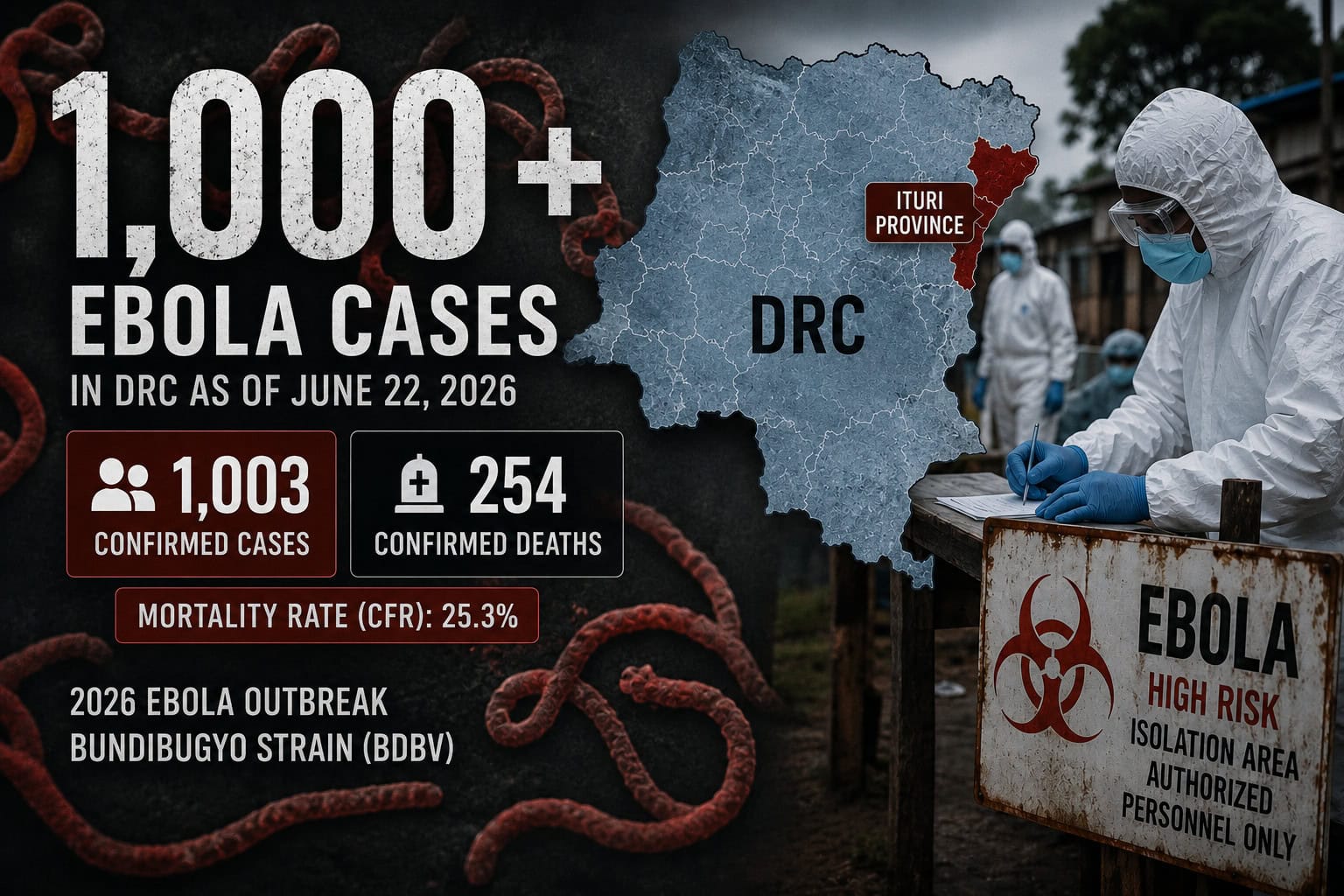
The ongoing 2026 Ebola outbreak in the Democratic Republic of the Congo (DRC) continues to worsen, with health officials reporting 1,003 confirmed cases and 254 confirmed deaths as of June 22, 2026. The outbreak is centered primarily in Ituri Province in eastern DRC, with limited cross-border spread into Uganda.
This outbreak is caused by the rare Bundibugyo strain (BDBV) of the Ebola virus, a significant concern because there is currently no approved vaccine or targeted antiviral treatment for this species.
While the current case fatality rate (CFR) of 25.3% is lower than that of many historic Ebola outbreaks, public health experts warn the true mortality rate could rise as delayed diagnoses, underreporting, and gaps in contact tracing continue to complicate containment efforts.
Unlike prior outbreaks involving the more lethal Zaire strain, the Bundibugyo species typically causes lower mortality but remains highly dangerous, especially in regions with limited healthcare infrastructure.
Why the 2026 Ebola Outbreak Is Especially Concerning
Within weeks of the declaration, it became the largest Bundibugyo Ebola outbreak ever recorded and one of the fastest-growing Ebola outbreaks in modern history. Response teams face multiple obstacles:
- Ongoing armed conflict in eastern DRC
- Limited road access to remote villages
- Community mistrust of health workers
- Overcrowded displacement camps
- Insufficient contact tracing coverage
Reports indicate only ~55% of known contacts are currently being monitored, leaving a significant opportunity for continued transmission. Health officials also remain unable to definitively identify “patient zero,” making containment more difficult.
| Outbreak (Year) | Virus Species | Cases | Deaths | Mortality Rate (CFR) |
|---|---|---|---|---|
| Current Outbreak (2026) | Bundibugyo | 1,003 | 254 | 25.3% |
| West Africa Epidemic (2014–2016) | Zaire | ~28,600 | 11,325 | ~40–63% |
| DRC / Kivu Epidemic (2018–2020) | Zaire | 3,470 | 2,280 | ~66% |
| Uganda Outbreak (2022) | Sudan | 164 | 55 | ~34% |
| Isiro, DRC (2012) | Bundibugyo | 57 | 29 | ~51% |
| Bundibugyo, Uganda (2007) | Bundibugyo | 149 | 37 | ~25% |
| Yambuku, DRC (1976) | Zaire | 318 | 280 | ~88–90% |
What the Numbers Tell Us
1. Lower Fatality Does Not Mean Lower Risk
- The 25.3% mortality rate may initially appear less severe than historic Ebola outbreaks, but that can be misleading.
- The Bundibugyo strain has historically shown mortality rates between 25% and 50%, compared with 60% to 90% for the Zaire strain. This means patients may survive at higher rates if they receive supportive medical care quickly.
- However, if treatment capacity becomes overwhelmed, mortality can climb rapidly.
2. This Is Already the Largest Bundibugyo Outbreak Ever Recorded
- Before 2026, the two major Bundibugyo outbreaks were:
- Uganda (2007): 149 cases
- DRC (2012): 57 cases
- At 1,003 confirmed cases, the current outbreak is nearly:
- 7× larger than the 2007 outbreak
- Nearly 18× larger than the 2012 outbreak
- That scale alone makes this outbreak historically significant.
3. No Approved Vaccine Exists for Bundibugyo Ebola
- One of the most serious concerns is the absence of a licensed vaccine.
- During the 2018–2020 Kivu outbreak, responders used Ervebo, a vaccine effective against the Zaire strain, to help contain transmission.
- Unfortunately, Ervebo does not protect against Bundibugyo virus.
- This leaves healthcare workers dependent on:
- Early detection
- Rapid isolation
- PPE compliance
- Contact tracing
- Supportive treatment
- Without these measures, healthcare systems can quickly become overwhelmed.
Outlook for the 2026 Outbreak
Health officials warn the outbreak has not yet peaked.
If containment efforts fail to improve, case counts could continue climbing sharply in the coming weeks. While the Bundibugyo strain may be less lethal than other Ebola variants, the combination of fast transmission, weak healthcare access, regional instability, and no vaccine availability creates a highly volatile situation.
The outbreak serves as another reminder that global health emergencies require rapid response, resilient healthcare systems, and the ability to quickly expand isolation and treatment capacity when local resources become overwhelmed.
BLU-MED Response Systems® has supported healthcare and disaster response operations during multiple large-scale public health emergencies, including the 2014–2016 West Africa Ebola epidemic in Monrovia, Liberia, where deployable treatment infrastructure helped expand patient isolation and surge treatment capacity.
Purpose-built negative-pressure isolation facilities can offer significant advantages over improvised structures by improving infection control, climate management, patient-workflow separation, and long-term operational reliability.